01 · Question
One falsifiable projected measurement question
In a pre-declared, source-masked XMM EPIC source-plus-background analysis, can an absolute, radius-dependent soft X-ray surface-brightness profile P(r) − B(r) be measured within the frozen sector beyond IC 10's optical body (5′–20′, i.e. 0.96–3.84 kpc), or can a qualified upper bound be produced?
"Absolute" here is not rhetoric. It means: the measurement must be defined against a pre-frozen, radius-dependent background model B(r) (QPB + CXB + SWCX + residual soft protons + Galactic foreground), not against another sector or another assumed "blank" region. None of these qualification conditions are yet complete.
02 · Why it matters
Existing work saw soft X-rays inside IC 10; it has not answered whether the outside can be measured absolutely
Wang, Whitaker & Williams (2005, MNRAS 362, 1065) used XMM and Chandra to establish a diffuse soft X-ray component inside IC 10 (0.6–2.4′) and documented severe contamination from the X-1 readout streak and point-source PSF wings. Laycock et al. (2017, ApJ 836, 50) established a 111-source Chandra catalogue. Taken together, these mean: IC 10's internal hot gas is established, but "can a current, source-masked, per-camera EPIC external-profile operator recover or constrain an absolute projected profile" remains open.
The value of I176 is to turn this measurability premise into a narrow, explicit test: if EPIC can recover the external profile at the nearest distance of 0.66 Mpc, then more distant external hot-gas programmes such as I174/I175 gain an absolute reference point; if not, those programmes' "external detectability" premise is quantitatively weakened.
This is not "rediscovering hot gas." A single projected measurement of one galaxy can only update the evidence for IC 10 at this angular scale, this model, and this sensitivity. It cannot validate any population-level or cosmological prescription.
03 · Sky geometry
Archival coverage reaches the centre; the external 5–20′ domain has never been on-axis sampled
IC 10's RC3 D25 is 8.0′ × 7.0′, PA=90°; the aimpoints of the two existing XMM observations (0152260101, 0693390101) both lie at 0.000′ from the nucleus, i.e. at the X-1 centre. This means the r > 5′ external domain always sits at large off-axis angles, in a vignetting- and background-dominated edge. The figure below uses the true nucleus-centred WCS; it shows nominal sky geometry only and does not freeze I176's region, mask, GTI, or detector footprint.
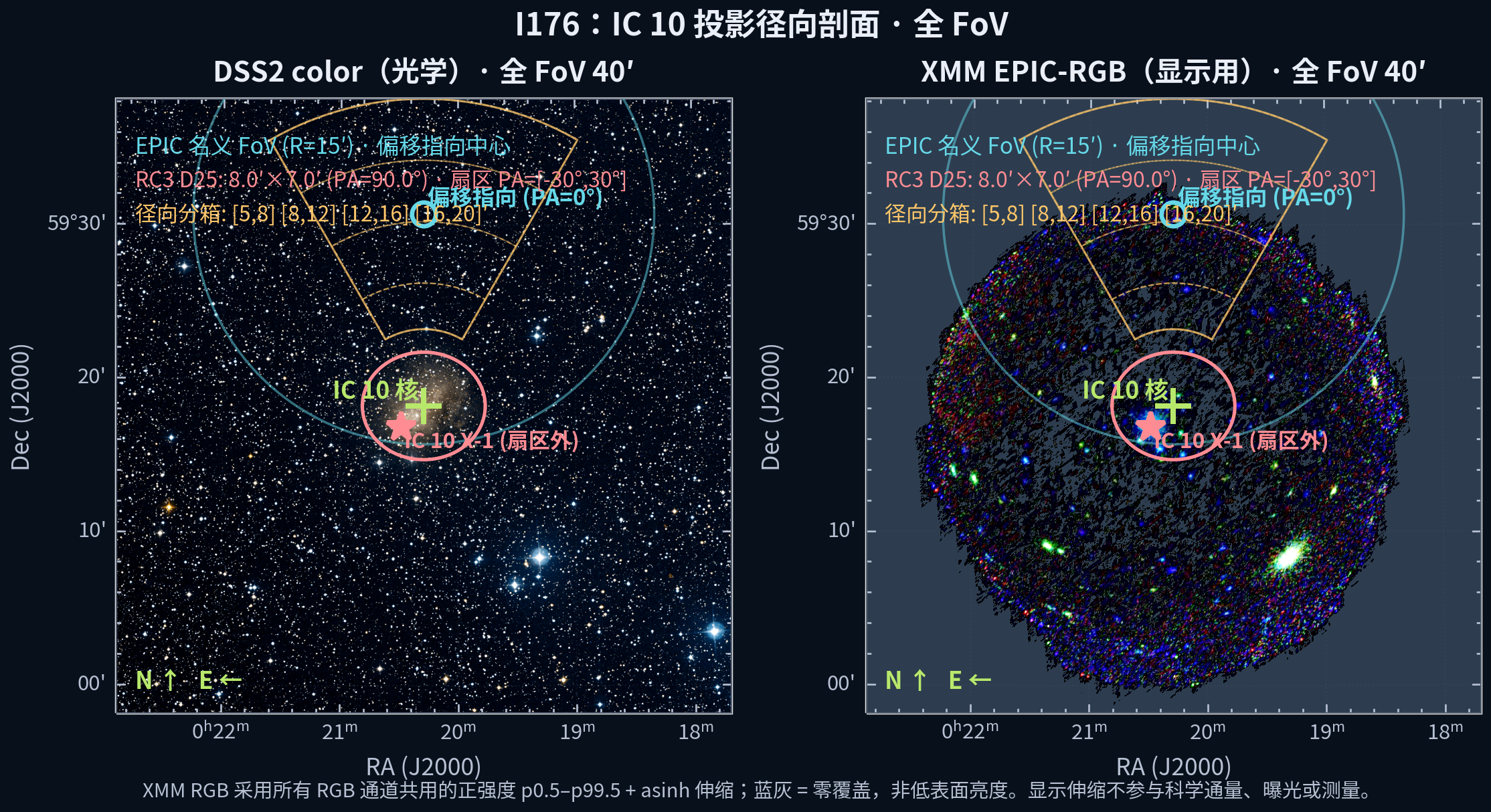
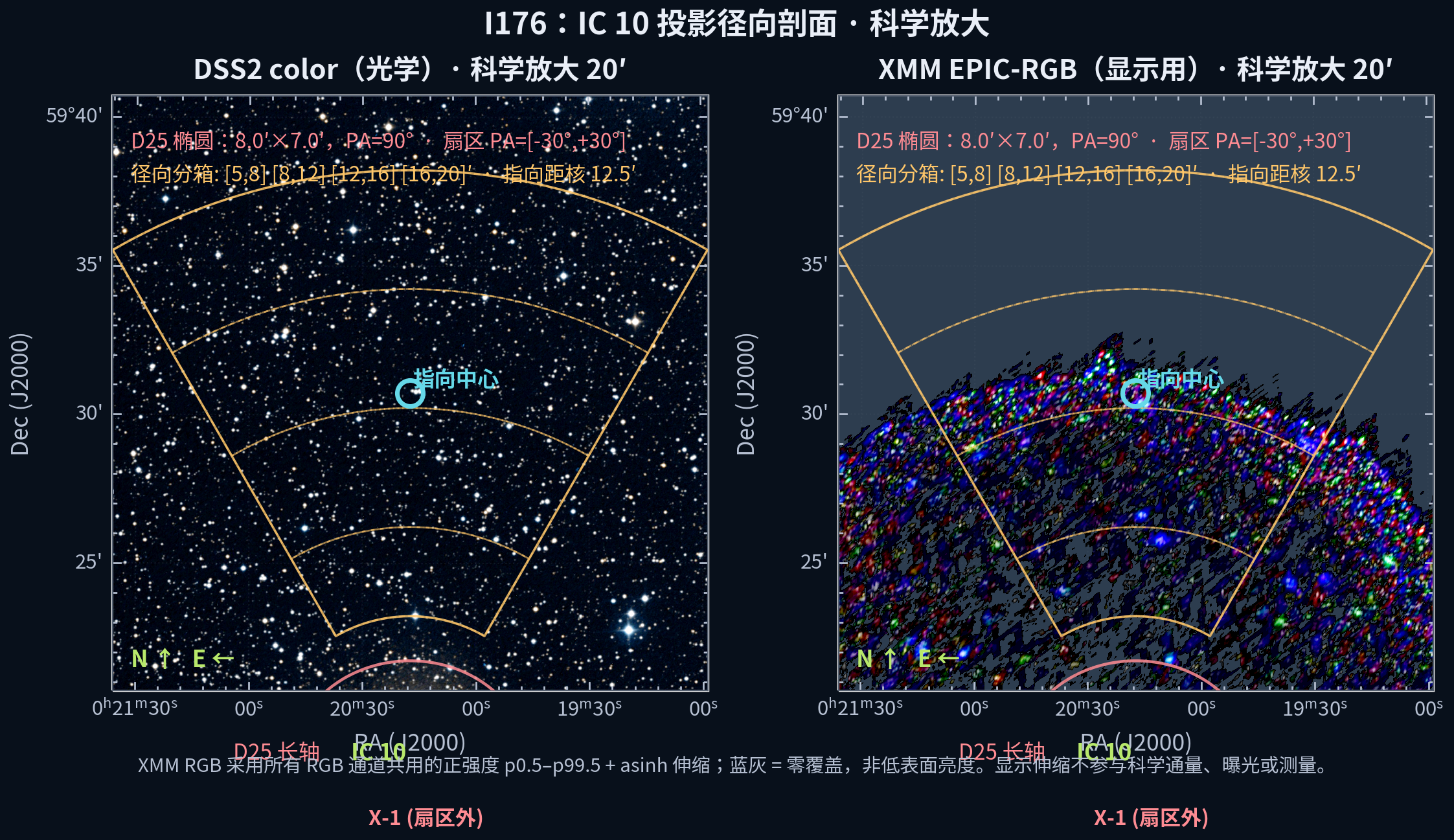
The XMM RGB uses a positive-intensity p0.5–p99.5 percentile clip shared across all channels and an asinh stretch; blue-grey marks zero coverage, not low surface brightness. This display stretch plays no role in exposure correction, scientific flux, or the P(r) − B(r) measurement; the overlays use the original WCS.
04 · The number actually measured, and why the internal result cannot be reused
The measurement is a projected profile, not "is there hot gas"
Once qualified, the pre-frozen primary quantity is P(r) − B(r): the per-camera projected surface-brightness profile within the frozen 5–20′ sector, minus a pre-frozen, radius-dependent absolute background model. A frozen finite interval is required: only if all qualification conditions pass and the interval excludes zero is it DETECTED PROJECTED PROFILE; only if the interval falls below the pre-declared material reference profile is it BOUNDED; everything else is INCONCLUSIVE or RADIUS-DEPENDENT / MIXED.
05 · If the answer comes out the other way, or cannot be answered at all
An honest BOUNDED is informative; an unqualified null is not
- DETECTED PROJECTED PROFILE: in the frozen response domain, the
P(r) − B(r)interval excludes zero. It supports only the external soft component under this projected model. - BOUNDED: at the sensitivity that has met the recovery/coverage standard, the upper bound still falls below the pre-declared material reference profile. It weakens the claim of "external EPIC detectability"; it is not equivalent to "there is no hot gas."
- RADIUS-DEPENDENT / MIXED: some frozen bins are detected, some are bounded. This is a measurement result, not a physical null.
- INCONCLUSIVE: if any of the GTI, detector/mask, background, response, or injection/recovery qualifications fails, no physical conclusion is drawn. Such a null is boring and does not deserve to be dressed up with pretty graphics.
06 · Cost, and the cost still unknown
The single request of this page: first authorise one qualification HEAVY, not observing time
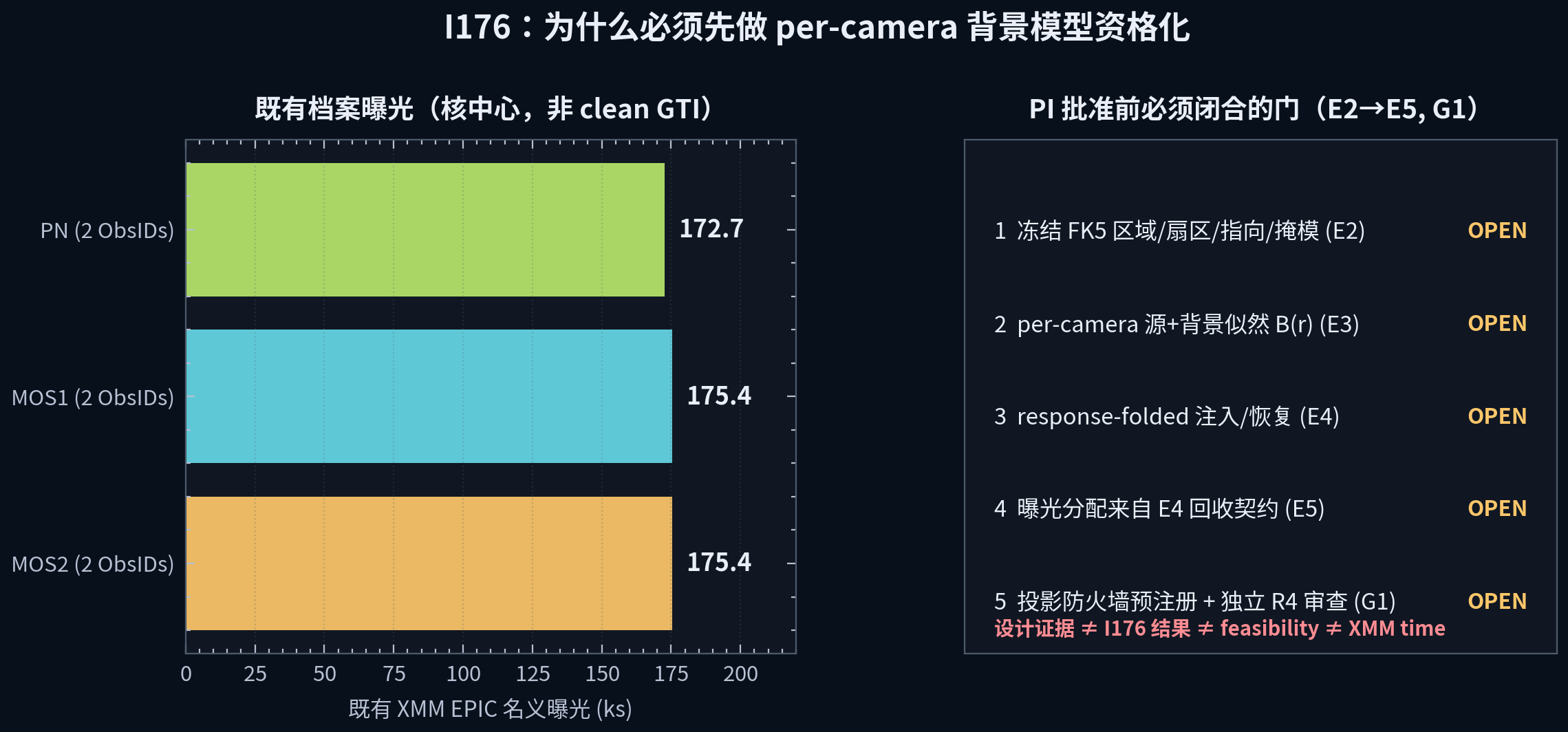
The next step R5 left for I176 is developing: one R6 work package must freeze the EPIC FK5 region, GTI/LIVETIME, source mask, retained area, background model B(r), per-camera response, and a fixed-seed response-folded injection/recovery (covering multiple truth scenarios).
The nominal exposures PN 172.679 ks / MOS1 175.366 ks / MOS2 175.384 ks are only scheduled duration, not clean GTI and not a sensitivity calculation. Actual clean time, source brightness, detector gaps, vignetting, post-mask area, background, and the recoverable material threshold are all unknown. If this HEAVY qualification fails, the correct action is to stop at INCONCLUSIVE, not to package unknown cost into a proposal.
Actionable choice for the PI
Approve: approve only the R6 HEAVY qualification package above; it does not automatically approve an XMM time request.
Do not approve: stop here. This page has already stated that there is currently insufficient evidence to commit observing time or to claim a halo/CGM result.
Sources and reproducibility
Evidence boundary of this page
- Wang, Whitaker & Williams (2005), An XMM-Newton and Chandra study of the starburst galaxy IC 10, MNRAS 362, 1065. arXiv
- Laycock et al. (2017), The X-Ray Binary Population of the Nearby Dwarf Starburst Galaxy IC 10: Variable, ApJ 836, 50. arXiv
- Local traceable inputs: the I176 idea card, R3 evidence, R4 critique, R5 adjudication, IC10 source card, and the frozen HiPS2FITS display inputs of this page. All hashes, commands, and replay paths are recorded in the publication manifest.